A Sunk Cost Is Best Described as
Cost is defined very broadly and can include things like money time or energy. Im probably best described as a casual gamer.

What Are Sunk Costs Definition And Meaning Market Business News
Any future costs associated with future decisions of the firm.

. It is not a relevant cost in decision making but is part of the traditional accounting records. Even if you do not recognize your behavior as one of the two patterns described you may still fall victim to the sunk cost fallacy. Managerial options implicit in a project.
Costs of ingredients that firm uses to make food it sells to customers. Which of the following is a sunk cost. Purchase price of vehicle to be traded in.
Opportunity costs involved with a project. The costs of electricity and utilities the firm uses each month. Contribution margin per unit is best described by which of the following.
Fixed costs that may be avoided in the future are referred to as. Obviously the bugsmatchmaking troubles in MCC are disappointing. Solution for A sunk cost can be described as which of the following.
In most instances a variety of costs are sunk because peoples resources tend to be highly interconnected. A a cost which is irrelevant for the future B a cost which must be matched against the revenue C a cost which remains the same at all levels of production D a cost which varies with the level of production. Select all of the following that are best described as sunk costs.
A sunk cost is described as which of the following. 5 A sunk cost is described as which of the following. The costs associated with a massive ad campaign the firm ran last month.
In economics and business decision-making a sunk cost also known as retrospective cost is a cost that has already been incurred and cannot be recovered. Fixed costs that cannot be traced directly to a product line. It is defined as a tendency to continue an endeavor once an investment in money effort or time has been made Arkes and Blumer 1985 p.
Which of the following best describes sunk costs. A sunk cost is a cost that has already been paid for and cannot be recovered in any way. Which of the following best describes sunk costs.
It therefore should not be a factor in our current decision-making because it is irrational to use irrecoverable costs as a rationale for making a. Fixed costs that do not differ between two alternatives are. A historical cost Cannot be changed regardless of future actions taken.
Which of the following is a sunk cost. Which statement best describes a sunk cost. I owned 3 games for Xbox 360 Halo 3 Reach Madden 10 and I dont anticipate buying anything more for Xbox One that what ive got now madden 15 MCC.
AThe cost of an expensive pair of shoes that I want but will likely never wear. Costs of ingredients that firm uses to make food it sells to customers. Irrelevant to the decision.
Any future costs associated with future decisions of the firm. This is the sunk cost fallacy and such behavior may be described as throwing good money after bad while refusing to succumb to what may be described as cutting ones losses. One of the best-known effects which is considered a cognitive bias is the sunk-cost effect.
For example many important decisions require not only more salient and measurable costs such as time and money but also those which people feel more personally such as effort and emotion and each may feel the weight of those costs differently. The cost of an asset that the company is considering replacing. The costs of electricity and utilities the firm uses each month.
In economic terms sunk costs are costs that have already been incurred and cannot be recovered. Optional capital requirements of a project. Sunk costs related to a project.
2 it is a relevant cost in decision making but is not part of the traditional accounting records. Irrelevant to the decision. A sunk cost is any cost that must be expended in order to complete a project and bring it into operation.
Economic effects on a projects profitability. Which of the following best describes an opportunity cost. Related Discussions- Sunk costs.
Sales price per unit minus variable cost per unit. CThe additional money you must pay if. A One that is relevant to a decision because it changes depending on the alternative course of action selected B A historical cost that is always irrelevant C An outlay expected to be incurred in the future D A historical cost that may be relevant.
A sunk cost is best described as. A sunk cost is a cost that was incurred and expensed in the past and cannot be recovered if the firm decides not to go forward with the project. The costs associated with a massive ad campaign the firm ran last month.
Fixed costs that do not differ between two alternatives are. Why sunk costs Cannot be recovered. Sunk costs are contrasted with prospective costs which are future costs that may be avoided if action is taken.
BThe non-refundable deposit made a month ago to hold your spot on a rafting trip. So like many people I purchased a Xbox One just for the MCC. Purchase price of vehicle to be traded in.
Costs incurred in the past that cannot be changed by future decisions. 1 In the previous example the 50 spent on concert tickets would not be recovered whether or not you attended the concert. The sunk-cost fallacy occurs every time an unrecoverable cost influences future decision making.
Fixed costs that may be avoided in the future are referred to as. A sunk cost can be described as which of the following-Historical Cost-Always irrelevant -Cant be changed regardless of future action. Costs that can be avoided by selecting a particular course of action.
A historical cost that is always irrelevant. In other words a sunk cost is a sum paid in the past that is no longer relevant to decisions about the future. The correct answer is.

Beware Of The Sunk Cost Fallacy When Planning Your It Investments
What Is Sunk Cost Definition Examples Faqs
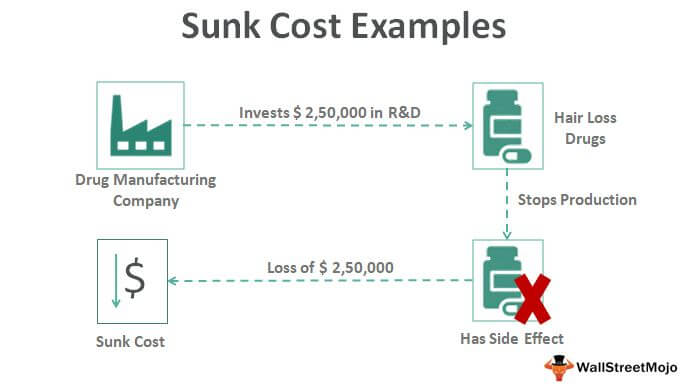
Sunk Cost Examples Top 4 Examples With Explanation


Comments
Post a Comment